Honda Odyssey Active Motor Mount (ACM) Vibration Failures: Cost of OEM Hydro Mount Replacement
You’re sitting at a stoplight, foot on the brake, and the steering wheel starts to vibrate. Then you accelerate and feel a thunk from under the hood, like something is shifting that shouldn’t be.
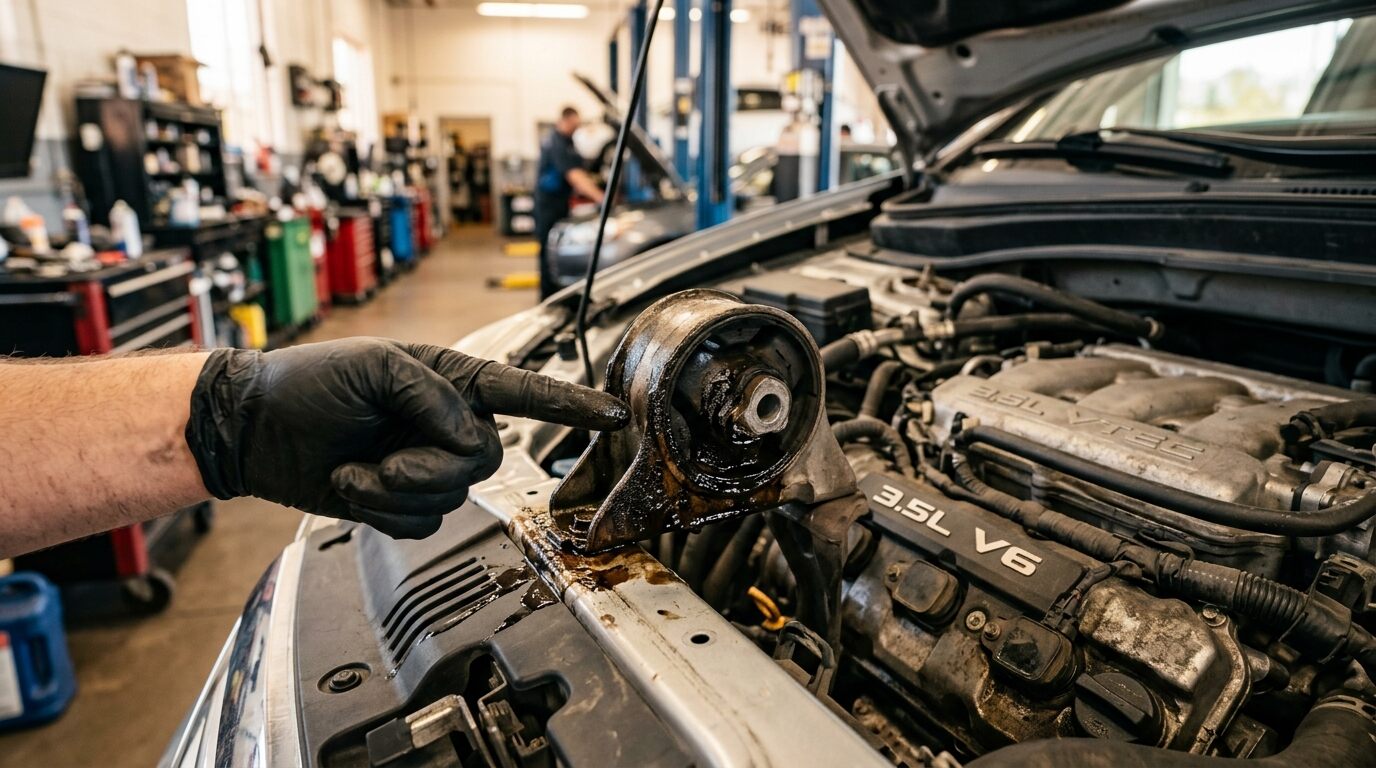
If you own a Honda Odyssey with the 3.5-liter V6, this is often the Active Control Motor Mount (ACM) system. These sophisticated mounts are prone to failure, often leaking a thick fluid. While the repair isn’t cheap, understanding the costs and causes can help you make the best decision for your van.
TL;DR
Honda Odyssey ACM failures cause cabin vibrations, clunks during gear shifts, and rough idling. These costly mounts are the front and rear active engine mounts—they can cost over $600 each for the part alone. A full professional replacement of multiple mounts costs around $2,500. While you can sometimes replace just one faulty mount, replacing all of them at once can save you money on labor in the long run. On some models, disabling VCM can extend the life of new mounts.
The ACM System: What It Is and Why It Fails

Honda’s ACM system was introduced to help reduce the engine vibrations inherent with the Variable Cylinder Management (VCM) system, which shuts down cylinders for fuel economy. These “active” engine mounts are computer-controlled and can change their stiffness to counteract vibration.
There are two main active mounts on the Odyssey: a front mount and a rear mount. They are filled with a fluid that helps them perform their damping function. When an ACM fails, it often leaks this fluid and can no longer effectively isolate engine vibrations.
Which Odyssey Models and Years Are Affected?

The ACM system has been used on the Odyssey since the introduction of VCM on the 2005 model year, but failure reports are most concentrated on the fourth-generation (2011–2017) and fifth-generation (2018–present) vans. The 3.5-liter J35 V6 paired with VCM is the common thread—if your van shuts down cylinders to save fuel, it almost certainly has active mounts. Higher-mileage examples (100,000+ miles) and vans used primarily for short-trip, stop-and-go driving tend to see failures earlier.
Why VCM Accelerates Mount Wear

When VCM deactivates cylinders, the engine’s vibration signature changes abruptly—and repeatedly, every time cylinders re-engage. The active mounts are constantly adjusting to absorb these transitions, which means their internal solenoids, vacuum chambers, and fluid bladders cycle far more often than a conventional mount ever would. Over time, the rubber degrades and the fluid escapes. In this sense, the ACM is a wear item designed around a fuel-economy feature—which is why many owners view mount replacement as an indirect cost of VCM.
Cost of OEM Active Motor Mount Replacement
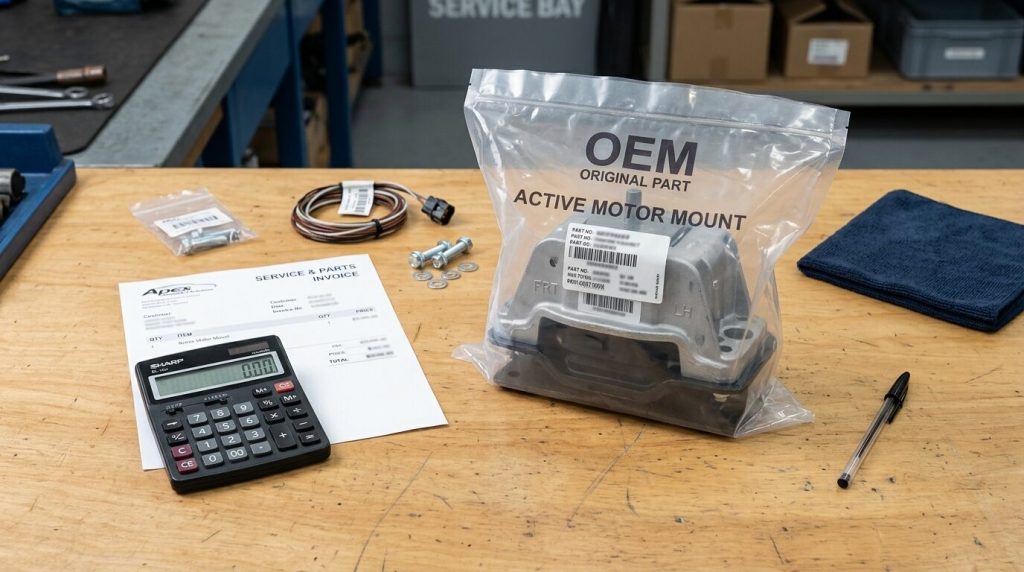
The primary cost drivers are the parts, specifically the active mounts, and the significant labor involved.
Part Costs (OEM)
- Front/Active Engine Mount: Typically an assembly with an ACM control unit. For many models, this part can cost around $500 or more.
- Rear ACM Assembly: Another large and expensive component, often costing between $400 and $600.
- ACM Control Unit: For newer models (2020+), the system’s control module itself can cost over $400.
Total Replacement Cost
For a repair that replaces multiple broken mounts (which is common), the cost can be significant. One Car Talk reader was quoted about $2,500 for labor and materials to replace front, rear, and side engine mounts. Industry experts note that this estimate is “in the right ballpark” for a professional repair.
What’s Included in a Typical Quote

A professional estimate usually breaks down into:
- Parts: Front and/or rear active mount assemblies, plus the ACM control unit on 2020+ models
- Labor: Typically 4–8 hours depending on which mounts are replaced; rear mount service often requires subframe lowering
- Incidentals: New mounting bolts (many are torque-to-yield and should not be reused), vacuum line inspection, and possibly a relearn/reset of the ACM control module
- Alignment: Recommended after subframe work on rear mount replacements
Aftermarket vs. OEM: What to Know
Budget aftermarket active mounts exist, but owner reports are mixed—some units fail within a year, while others hold up reasonably well. Given the labor cost involved, many owners choose OEM or reputable OE-equivalent brands to avoid paying for the job twice. Passive (non-active) mount conversions are covered in the FAQ below, but they trade refinement for simplicity.
Warranty and Goodwill Coverage
If your Odyssey is still within the powertrain warranty window, mount failures may be covered—powertrain coverage on newer Hondas extends to 5 years/60,000 miles, and some owners have received goodwill assistance on vans just outside warranty. It’s worth asking the dealer to submit a goodwill request, especially if the van has a full service history at Honda.
Symptoms of a Failing ACM
Recognizing these symptoms can help you catch a failure early:
- Vibration at Idle: You’ll often feel a shake in the steering wheel or cabin when stopped in Drive.
- Clunking or Thumping: You may hear or feel a loud thud when shifting from Park to Reverse or Drive, or when accelerating from a stop.
- Engine Movement: With the hood open and the vehicle in Drive with the brakes on, the engine may visibly shift more than an inch when revved.
- Fluid Leaks: A visible leak of thick, oily fluid (often black, brown, or blue) from the mount area is a clear sign of failure.
Vibration Under Load or at Highway Speed
Beyond idle vibration, a failing mount can transmit a drone or buzz through the floorpan and pedals during light-throttle cruising—particularly when VCM is active. Some owners describe it as a “mooing” or resonating hum between 40–60 mph.
Worsening Symptoms Over Time
ACM failures rarely happen overnight. A mild idle shake that gradually becomes a pronounced thump on every shift is the classic progression. Catching it at the vibration stage usually means replacing one mount instead of three.
Diagnostic Codes
On 2018+ models, a failed ACM control unit or circuit may set a stored code retrievable with an OBD-II scanner. A code doesn’t always accompany a mechanical fluid leak, though—so a visual inspection still matters.
Prevention and Long-Term Ownership Tips
- Disable VCM early. Deactivator kits (inline modules or tuner-based solutions) are the single most-recommended preventive step in the owner community. Installing one on a van with healthy mounts can delay the first failure; installing one alongside new mounts protects your investment.
- Address leaks promptly. A weeping mount is a warning, not a death sentence—but the fluid loss is irreversible.
- Inspect mounts at every oil change once past 75,000 miles, especially the front mount, which is easiest to see.
- Replace in pairs when practical. If the front mount has failed, the rear is often close behind; doing both in one labor session is usually cheaper than two separate visits.
- Keep service records. Helpful for goodwill claims and for resale.
Real Owner Cost Reports
Estimates vary by region and shop type, but owner-reported figures cluster around these ranges:
| Scenario | Typical Reported Cost |
|---|---|
| Single front ACM, independent shop | $700–$1,000 |
| Front + rear ACM, independent shop | $1,500–$2,000 |
| Full set (front, rear, side), dealer | $2,200–$2,800 |
| ACM control unit (2020+), parts only | $400+ |
Dealer labor rates run higher than independent shops, but dealers are more likely to have the subframe-lowering procedure down to a routine. Getting two quotes—one dealer, one Honda-specialist independent—is the standard advice.
When to Repair vs. Replace the Van
If you’re facing a $2,500 mount job on a high-mileage Odyssey, it’s fair to weigh the repair against the van’s value. As a rule of thumb, a repair costing less than a third of the vehicle’s current market value is usually worth doing—especially since the J35 drivetrain is otherwise long-lived. Mounts are a maintenance cost, not a terminal diagnosis.
Frequently Asked Questions
What is the difference between an ACM and a standard motor mount?
An ACM is an active, computer-controlled mount that changes its stiffness to counter engine vibration. Standard mounts are passive, solid rubber components.
How do I test if my ACM has failed?
A common test is to have someone shift the vehicle between Drive and Reverse while you observe engine movement. You can also disconnect the vacuum to the control solenoid; if the idle quality doesn’t change, the system may have failed.
Why are ACM replacements so expensive?
The parts are costly (OEM active mounts can be over $500 each), and the labor is extensive. Replacing rear mounts often requires lowering the subframe, adding significantly to the time.
Can I just switch to cheaper standard mounts?
Some owners have successfully converted to standard mounts after disabling VCM, but opinions are mixed. It’s an option, but it may not provide the same level of cabin refinement.
Is it necessary to replace all the mounts at once?
No, but it’s often recommended. If one mount has failed, the extra strain can accelerate wear on the others. Replacing them all at once can save on future labor costs.
How long do replacement ACMs typically last?
Owner reports vary widely—some replacements last 80,000+ miles, while others fail again in 30,000–40,000 miles, especially if VCM remains active. Disabling VCM is the most commonly cited way to extend replacement life.
Does the ACM failure affect safety or just comfort?
It’s primarily a comfort and drivability issue, but excessive engine movement can stress other components—exhaust flex joints, hoses, and wiring—so it’s not something to ignore indefinitely. It won’t typically cause a sudden loss of control.
Can I drive with a failed ACM?
Yes, in most cases—but expect worsening vibration, clunking, and accelerated wear on the remaining mounts. Plan the repair rather than deferring it long-term.
Sources and Methodology
Cost figures in this article are drawn from owner forums, published quotes (including the Car Talk reader estimate cited above), and industry commentary. Prices vary by region, model year, and shop type. Repair cost ranges reflect commonly reported figures and should be treated as estimates, not guarantees—always obtain a written quote for your specific vehicle.
If you’re out of warranty and want to prolong the life of your new mounts, the owner community is strong—disabling the VCM system with a deactivator kit can help prevent the conditions that stress your new mounts. Investing in OEM or high-quality aftermarket parts and a professional installation is the best way to restore that silky-smooth Odyssey ride.
Have you had to replace active motor mounts in your Odyssey? Share your experience and cost in the comments below.
For further reading and official resources: